Do I Need My Brakes Looking At?
If you have concerns over your brakes, the best idea will be to come get them checked over. Usually, there are tell-tale signs that something isn't right.
Common Warning Signs
Grinding: The most common concern over brakes, this will indicate the brakes are worn and there isn't enough material on the brake pads. The term 'metal to metal' is used — these should be looked at straight away because it's likely to damage the disc.
Squeaking: There are many reasons why your brakes might squeal, but the most common is that your calliper has seized and the brake pad remains touching the brake disc. Best way to know will be to get them checked out as another problem could occur.
Pulsating: A continuous pulsating from the brake pedal could indicate the brake disc is warped. This is due to excessive heat and causes the brake disc to be distorted, meaning there isn't a flat surface for the brake pad to make contact. If it isn't a warped disc it could be the ABS, either way it's best to get them checked out.
Pulling: A vehicle pulling left or right could indicate a seized calliper. A full inspection will be required as this could lead to more implications.
Sponginess: If the brake pedal is spongy and seems unresponsive there could be some air within the brake lines, therefore preventing the brake fluid from flowing through this system effectively.
Soft Brake Pedal: If the brake pedal is limp and goes all the way to the floor get it checked immediately as this could indicate a serious fault. There are various problems this could indicate, including brake fluid that is ineffective and needs replacing or, more seriously, a fault with the master cylinder.
Dashboard Light: If the brake warning light is lit or keeps coming on when the Brake is applied it could indicate the brake fluid is critically low or there is a leak in the brake hoses.
High Handbrake: A high handbrake could mean it needs adjusting, usually anything more than 6-8 clicks. This is an MOT failure and needs replacing or adjusting.
Old Brake Fluid: Old fluid won't be as effective as new brake fluid because of its hygroscopic properties meaning it absorbs moisture over time. This will have a negative effect on braking ability. Brake fluid should be changed every two years to ensure effective braking systems, check your manufacturer's handbook for more information.
The Importance of Brake Fluid
Brake fluid is essential for your safety. It's a hydraulic fluid that transfers the force from your foot on the brake pedal to the brakes on your wheels. Over time, brake fluid absorbs moisture from the air, which lowers its boiling point and can lead to brake failure, especially under heavy braking conditions. It can also become contaminated with dirt and debris.
We recommend a brake fluid change every two years, regardless of mileage, to ensure your braking system operates safely and effectively. We can test your brake fluid's moisture content and replace it if necessary.
When Should I Replace My Brakes?
If you are a motorway driver your brakes could last up to 60,000 miles, whereas a city driver's may only last 25,000 due to more frequent braking than on the motorway. Front brakes normally wear out before rear brakes because of the higher percentage of braking loads, even more so on front wheel drive vehicles. The rule of thumb is that if the brake pad thickness is below 3 millimetres they should be replaced. Brake disc thickness should be measured and referenced back to the manufacturer's safe minimum thickness. Replacing brakes should be done in pairs to ensure equal performance. Once new brakes are fitted it's important to drive carefully and gently until you've bedded the brakes in — this process takes approximately 200 miles.
How Do Brakes Work?
The force applied to the pedal is multiplied through leverage which then, in turn, initiates a hydraulic system. Hydraulic systems run on incompressible fluids, in this instance brake fluids. The force at one end pushes a piston into a brake line, which pushes the fluid through the line and pushes a piston out at the other end, applying friction to the wheel. This is the braking system. This friction is relayed through the tyres to the ground and the vehicle comes to a stop.
Different Braking Systems
Drum Brakes
Drum brake systems are commonly used on the rear of a vehicle, the hydraulic system is initiated by pressing the brake pedal which causes two shoes inside a drum to move outwards making contact with the inner surface of the drum, causing resisting friction. The drum is connected to the wheel, so in this instance, results in friction being transferred from the drum to the wheel and causes the vehicle to stop.
Disc Brakes
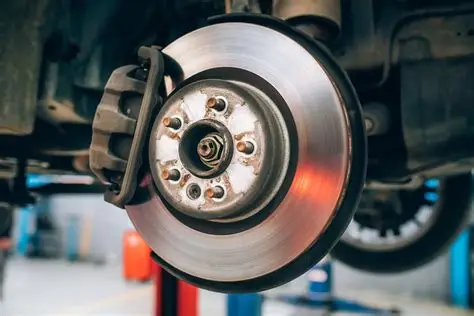
Disc brakes may be on the front wheels or, more frequently, on all four wheels. The hydraulic system is initiated by pressing the brake pedal which causes two pistons to push two pads onto either side of a disc in a clamping motion. Brake discs are fixed to the wheels, therefore, when the pads clamp onto the disc, friction occurs and the wheels slow down bringing the vehicle to a stop.
ABS (Anti-lock Braking System)
ABS works on the principle that locked or skidding wheels will not create enough friction to stop the vehicle safely. So, ABS is there to assist the driver when elements out of their control prevent a safe stop. There are four main components to the ABS system: speed sensors, a controller, valves and pumps. Speed sensors on each wheel relay speed measurements to the controller, an on-board computer chip. Depending on the measurements the controller will operate valves in the brake fluid line to either remain open, close, or narrow to prevent brake lock. In instances where valves close or narrow, a pump is in place to restore normal fluid pressure back to the lines after the vehicle has stopped safely.
Book Your Repair
Facing an issue with your vehicle? Contact our Thirsk garage today.